
Interview with IAI Senior Instructor Joe Cool
This interview was conducted by Senior Instructor Kelly McDonald at the 2026 IAI Retreat in Tuscany, Italy.
IAI: Were you very young when you started training martial arts?
Joe Cool: Yeah, I was very young when I was first exposed to martial arts. My mother trained at the Aikido school in Boulder, Colorado, so some of my very early memories are of hanging out in the dojo and the Aikido school. My sister and I would be in the front office area and at the beginning of class they’d have a moment of meditation while they’re bowing in and you’d have to be very quiet. Every now and then someone would come over and scold us, and we’d go back to being quiet. So I grew up around “martial arts culture” and eventually I was part of the first kids’ group at that Aikido school. I can’t really say that I studied Aikido or have any great experience with it.
IAI: So you were about four years old or something when you did Aikido?
JC: Yeah, at that time I wasn’t really doing Aikido because Aikido’s not really
great for four year-olds. Then in elementary school, maybe in the fourth or fifth grade, a friend of mine and I did Aikido together for a couple of years. It was a kids’ class so it wasn’t super in-depth. I can’t claim to have any skill with it, but that was my first exposure to martial arts. And then because my mom was doing martial arts it wasn’t cool for me to do martial arts.
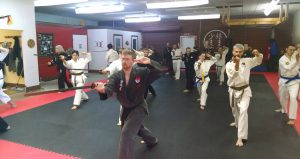
Some years later, when I was in high school a friend of mine had been training at this Shaolin school, she introduced me to Shaolin and I started training there. That was kind of my introduction to martial arts and it took like fire. I made some friends who were training there and there were some things about that school that were excellent, like conditioning and a variety of material. It was very engaging, lots to do, I trained in that system for about 20 years, but ultimately it wasn’t a very satisfying system to study because although there was wide variety of material – we did Tiger, we did Crane, we did 18 Classical Weapons, we did a lot of stuff – but it wasn’t a very deep method of training. We would learn a form and get shown a couple of applications, but gaining skill with a form at the Shaolin school was just about hitting with more power, just using muscular power, having lower stances, moving quicker and finding the right tempo, but rarely would someone say, “you need to do that far slower to explore the mechanics”. As long as you were doing the moves, doing them fast, doing them powerfully and doing them in a low stance….
IAI: As long as it looked good.
JC: Right. Then it was “correct.” So ultimately it wasn’t a long-term satisfying method.
IAI: Did you know that at the time?
 JC: No, I was very happy training there for a long time. There was a point at which I was eligible to test for fifth-degree black belt, I’d seen the material, I wasn’t current with all of it, but I could do some of it pretty well, and some of it I couldn’t do that well, but you don’t have to do everything perfectly, right? But I just kept demurring, I wasn’t interested in testing. And I think at that point I could have realized that I didn’t really want to do this system forever. There was something lacking, something that didn’t engage me.
My discovery that it was lacking unfolded a little bit at a time. Around 2012, Thad Wong, my school brother in Shaolin, started training Ba Gua Zhang with Tom Bisio. Thad had trained at the same Shaolin school as I had for a number of years and was teaching Shaolin in NYC at that time. We were chatting and Thad said, “I’d love to come out to Portland and show you what I’ve been learning.” So we invited Thad out and he taught a seminar on Ba Gua Zhang. We learned mud-stepping, Ji Ben Gong, Dao Yin and the Single and Double Palm Changes. Just a little bit of some basic material. I found the singular experience of working on mud-stepping was in many ways more satisfying than the previous 12 years of Shaolin training.
That in a single step – in just a single action – you could learn, focus on and notice things happening in your body, not just “go faster, go harder” from my Shaolin training. In Ba Gua Zhang it’s not just the key body alignments like “lift your head, sit your tail” – those are simply reminders we use. There’s objective qualitative feedback that you can get if someone is pressing on you as you walk. You can notice “if I follow the key body alignments then I can walk with more continuous, uninterrupted strength, more uninterrupted power.” And that was fascinating to me!

In contrast, while doing one of the Shaolin forms that I learned, if you do it lower, then the internal feedback was that your legs hurt more. You do it faster, the internal feedback was that you feel a little sloppier, but someone else watching says it looks really good. This was different from the feeling I get inside my body when I mud-step and follow my teachers’ advice, and drive through the heel. Something feels different inside the body. I can press better, I can feel a change in myself that I couldn’t with the more superficial corrections of “faster, lower”.
IAI: Are there things from your former training that you feel have benefited you in what you do now?
JC: Yes, absolutely. The physical conditioning. Well, that’s a double-edged sword, because on the one hand I don’t mind long hard days of training. I enjoy those. Or when you’re doing something arduous, I can handle that. But on the other hand, in physical conditioning you have intrinsically tighter muscle tissue that has to soften when you’re doing say, Heaven Uplifting Palm. When you’re doing San Ti, your shoulders have to soften to be able to hold the posture for a protracted period of time. So conditioning is a double-edged sword. But I think that ultimately it was a benefit so that now I have that muscle tissue to recruit in a softer way when I do Ba Gua or Xing Yi.

In Shaolin we also did a lot of sparring, so having a sense of timing and rhythms, how an application might be formed and what happens when someone’s right hand is moving towards you, and how you can pass that or intercept it with either of your hands has been useful. And we did a little bit of applications training, which trained the same skills as in Ba Gua Zhang but in a more regimented manner.

IAI: What do you mean, in a more regimented manner?
JC: I mean that it was like a strict application. If someone punches, then I do a particular application in a more proscribed fashion, rather than sparring.
IAI: Not feeling how something is going to happen…
JC: Yeah, where you get to invent in the moment. Our Shaolin training also included methods of Tai Ji, Ba Gua and Xing Yi. From my perspective now, none of them were very good. They lacked what I now consider to be the internal qualities that those systems are famous for. In Shaolin the slowness itself was the goal, instead of being a tool to explore the mechanics of the movements, and feel your body change.
As an example, at a certain level we learned a Ba Gua form, one of the forms that Jiang Rong Qiao taught. But the “mud-stepping” wasn’t mud-stepping as I understand it now. They did not train to move continuously with uninterrupted force. The way we trained 8 Hands was standing in a horse stance and moving one hand through each of these shapes (Joe remembers and does the movements). Oh wow, I think I just did it. I haven’t done that in years (laughs). And not focusing on body connection while doing it but focusing on doing it with, what was the phrase we used? Dynamic strength, dynamic tension? It would be actively tense. It would be actively tense, but moving….which isn’t correct! That’s not helping you learn Ba Gua Zhang.

Similarly, the method of Xing Yi we learned at that time lacked internal qualities. It paid lip-service to being relaxed and focused on power generation from the start, which I think led to flaws in their Shaolin Xing Yi method. The method that we are studying now, the Li Gui Chang method of Xing Yi Quan, doesn’t regard power as the ultimate thing. It’s about the soft body and how that develops internal strength. Power isn’t what you try to do on day one. On the other hand, many of the basic forms like Pi Quan and Beng Quan and most of the animals taught in the Shaolin system are very similar in shape to Li Gui Chang’s method.
IAI: Do you think learning the Shaolin Xing Yi method helped you to learn Li Gui Chang’s system because the basic shape of the Xing Yi forms were similar?
Yes – it definitely gave me a head start on learning Li’s system – I didn’t have to worry about learning the choreography as much, and could try to pay attention to the nuances. Any time I learn a new piece of material, I have to go through a couple steps – can I remember the choreography, what move comes next, is this hand high or low… and then work on connecting the mechanics to the movement – how do I drive this from the Yao, how does the step move the hands. So having learned a method of Xing Yi where a bunch of the choreography was very similar definitely made it easier for me to start to grasp Li Gui Chang’s method.
So it’s clear there’s a common thread, but it’s not the same. A couple of years after Thad had come to Portland to teach Ba Gua Zhang, JP Magenis came out to teach Xing Yi. My students were very curious about Li Gui Chang’s method of Xing Yi. I had conversations with JP comparing the two different ways of doing Xing Yi Chicken (demonstrates Shaolin method of Chicken). They are different but you can see this common thread, right? JP was very generous. He said, “I can see how you’re developing some good elasticity.” Thad told me I was doing Ba Gua and Xing Yi in a way that was more nuanced than how we had originally learned these arts. So maybe some of what I learned back then can be transformed into something more interesting….between you and me, the Shaolin Chicken and Dragon I just showed you feels more interesting now than it felt back then! So maybe there is something in that method….

IAI: Things have already changed though, Joe. I don’t know if you can do these forms the way you originally learned them anymore!
JC: I think that’s the other thing. If we were to watch a video of my test of that Shaolin material (though a video probably doesn’t exist), it would be like, ooh, that’s Xing Yi?!!
IAI: So when you started teaching, did you start out teaching Shaolin?
JC: Yeah, so I moved to Portland around 2006, expressly to teach Shaolin. There had been a Shaolin school in Portland and the instructor was moving on, and my Shaolin instructors liked to keep schools going.
IAI: Oh, so they basically sent you out there.
JC: I had expressed interest and there were a couple of other people who were interested. One of my Shaolin school brothers had gone out ahead of me to lay some groundwork and then I went out and took charge of the school. So in 2006 I moved to Portland, never having seen the city. In retrospect it was a little foolish but it’s been a great adventure and we essentially opened up a Shaolin martial arts school. We started teaching in a dance studio and that worked for a few years until there were enough students that I felt like we should have our own space so that we could increase hours, hang a heavy bag or whatever we wanted to do. So we found a space to lease and I operated that Shaolin school from 2006 till a little bit before the pandemic.

IAI: That’s quite some time.
JC: Yeah. Our lease was running out and the landlords wanted to almost double the rent. It was already too expensive. A couple of my students really felt that it was best to keep the space going and so they did, but I think it closed not long after the pandemic.
IAI: So when JP and Thad come to Portland to teach, they were teaching your Shaolin students? How did the students respond?
JC: You know, Thad is a very talented martial artist and teacher and has taken to Liang style Ba Gua Zhang very well. JP is an excellent communicator and teacher, and gives really excellent corrections; and Tom (Bisio) is a particularly talented teacher and had transmitted material very well to them both. And so everybody really enjoyed it, everybody really got a lot out of the seminars. But then….when it came time to practice the new material, it was more difficult.

As much as you have to eat bitter while doing the Shaolin system, there’s something more superficially satisfying about eating bitter in the form of doing a new and painful push up. It’s like western society, we’re trained “no pain, no gain”. But you get to choose your pain. Push-ups hurt and they make you sweat and you get endorphins and it feels good. Doing the slow walk, doing a one-minute mud step, awakens things in your body, like old injuries you haven’t addressed that can be uniquely uncomfortable. And you also have to confront yourself. When you’re doing push-ups with twenty other people in the class, you can kind of shut your brain off a little bit and just work out. You just kind of do the thing. But when you’re doing the slow walk, you have to confront your body and your mind. That’s all that there is. That was difficult for many of my students and some of them kept training Ba Gua Zhang, some of them stopped and have come back to it after a few years. And some of them decided that this method was not for them. Which is also okay, not everybody has to train in this method. They can make wrong choices (laughs).
But everybody really enjoyed those classes, especially some of the senior group who had seen the Jiang Rong Qiao Ba Gua form, so they had some superficial context for what Ba Gua Zhang was like. And then seeing how a more serious method of Ba Gua is trained, added some context and color to that. Seeing how Ba Gua could be applied, and seeing what those applications would do, was more interesting than the external way we did applications in the Jiang Rong Qiao system.
The Ba Gua applications we did in Shaolin were mostly deflect, block, hit – which is fine, but not very nuanced. Or sometimes we would do an interesting Qin Na application, but without any of the sense of connecting your body to someone else and disrupting their sense of root. Similarly with throws – we had applications in Shaolin where you sweep someone and put them in the air. In Liang style Ba Gua Zhang we have applications where you disrupt someone’s entire root and structure and they throw themselves. So it was interesting for some people to see how these principles could be applied, but not everybody wanted to do the training necessary to get to that point.

IAI: Right. I experience you and a few other people in the class as having a lot of facility and ability, particularly when it comes to applications. There’s a part of your body that knows how to give your partner something to work with. You can give them enough of a structure, you have enough of an understanding, so you’re able to just keep feeding things to that person so that they have something to contend with, to respond to. I just wonder if that ability has come from your previous training. If so, I would imagine it would be very beneficial.
JC: I think so. I think that comes out of sparring. When I would teach my students to spar, especially the very beginning students, the first thing we would do is to stand a little too far away from one another and do a slow punch right towards someone’s face. Because one of the hardest things to do in sparring is to see a fist coming right at your face. Another difficult thing for many people in sparring is to push your fist right towards someone’s face. Both sides of that coin can be very mentally challenging. And then you do it a little quicker and a little closer to where you’re just touching the nose with a fist and when you’re comfortable with that, well a little before that, the partner can deflect and you do basic drills with basic steps. So the willingness to hit someone is something that doesn’t come naturally to everyone, and honestly, shouldn’t. Societally, it’s something that we’ve decided we should try not to do and that’s a good thing. It’s also a good thing that we continue to train these martial arts because they have benefits beyond just the martial. But yes, if you can be comfortable with someone punching at you and getting hit and being thrown, within the confines of safety of course, it offers you so much more of an opportunity to learn. I’ve had students where you show them an application and they’re immediately running away or backing out of it. And I say, “no, no, come closer so I can lock out your elbow and throw you!” It can be hard to convince people to do that (laughs).
It makes it harder for a student not only to do the application but to do the form and technique correctly, if they don’t feel it done to them. When you get pushed, hit, thrown, locked, whatever, those things teach you intrinsically how to do that to someone else and thus how to do it when you’re practicing the form. So I would agree, that aspect of training has definitely been informative and helpful. Also, it’s really fun when Tom hits you. When he gives you a throw it’s scary. And it’s fun.

IAI: So tell us about the transition from teaching Shaolin to teaching Ba Gua Zhang.
JC: It was a transition over several years. After my school brother Thad Wong came out to Portland to teach a Ba Gua seminar (around 2012) I continued teaching at the Portland Shaolin Center until 2019. Over those years yes, there was a transition from teaching Shaolin to teaching primarily Ba Gua Zhang. Although even in the last few years of the transition I was teaching senior students the Shaolin material, conducting tests for all levels, doing occasional private lessons and trying to help people to refine the Shaolin material, at a certain point I stepped back from teaching Shaolin and a couple of my students chose to continue with it.

I found a space at a yoga studio and taught Ba Gua there for about a year until the pandemic hit, which of course disrupted everybody. The yoga studio closed, so we had about a year of teaching via zoom, which is not my favorite, but it was better than nothing. I was surprised at how well I could watch someone over video and still give good corrections that students were able to pick up and work on. For about a year we did that and had some discussion groups. My main group at that time was four or five people, we got together every Wednesday on Zoom and even when we started in-person classes again, we still maintained a Wednesday evening group and discussed the Ba Gua songs. Each week we’d discuss one or two songs, think about them, and read more than one translation. We had Tom’s translation initially. We had Vince Black’s translation, the Liang Zhen Pu book, and Andrea Falk has a wonderful translation of the Ba Gua songs. Later we also had Adam Wasserman’s translation. Eventually we could all cross-reference to see which words Vince would use, and Tom would use. We had some wonderful discussions on the Ba Gua songs and the 48 Methods and some other selected Ba Gua readings.
During this period, I transitioned to teaching in the park, which has been wonderful. In many ways I prefer it, I don’t have to worry about overhead or renting a space. It gives us more freedom and we train rain or shine. In really foul weather, people might not come but that’s fine. There’s a great Ba Gua song that says that “when it’s icy, walk with the front foot sideways” and that’s how you fight on the ice. I haven’t had to put that to effect yet.
IAI: I’m fascinated with the whole issue of going from a relatively external system to one that’s much more internal. For me, having been a dancer, there was nothing in dance warmups that I felt helped me feel ready to practice Ba Gua, even though dance warmups were how I had prepared my body to move for many years. Were there any exercises or warmups from Shaolin that you were reluctant to give up when you started Ba Gua Zhang? Or maybe you were just relieved not to have to do some of those things!
JC: So many of the Shaolin warm-ups were calisthenic in nature. We did a lot of push-ups. There was a period where I was teaching two classes, four days per week, and up to four classes on Saturday, and in many of those classes I’d do about 100 push-ups. So basically I was doing about 400-600 push-ups per week (laughs). And once I didn’t have to do that anymore, it was really lovely!
IAI: I guess you found enough of a structure with Ba Gua and Xing Yi so you didn’t just kind of pour yourself into nothingness, there was enough of a shape to put yourself in to explore.
JC: Right. This Ba Gua system is so great because we start with the Ji Ben Gong exercises, which are not just warmups, they also teach you how to move, and apply to everything else you do afterwards. It’s such a smart system. There are no meaningless exercises. Look, push-ups aren’t a meaningless exercise. They’re strengthening, so they’re very useful. We did push-ups on our fists, horizontal fists, vertical fists, reverse horizontal fists and yes, those correspond to some degree with the various ways that you strike. But there’s no way that you can do a push-up with the same explosive power with which you strike. So push-ups, in my opinion, don’t directly translate to a martial skill, whereas the Ji Ben Gong exercises do.
My favorite exercise is shoulder rotations. I just find them endlessly interesting. Shoulder rotations translate directly to Piercing. And directly to the Single Palm Change. And if you do them in the other direction it’s the Double Palm Change. And it’s piercing, it’s opening the shoulder tissue. It’s Pi Quan or Windwheel Chopping Palm and it’s rotating the Yao. Shoulder rotations also relate to several of the Eight Hands. Many exercises throughout Ba Gua Zhang can be related back to shoulder rotations. If you’re having trouble with a particular movement, do some more shoulder rotations.
And of course you have all the other Ji Ben Gong, and it’s the same principle, each exercise relates directly to our forms and techniques You can find some part of the Teacup exercise six times in the Double Palm Change. The Shaolin exercises, on the other hand, are primarily calisthenic in nature, or basic punching and blocking drills that don’t necessarily translate to building skill.
IAI: It’s very interesting, you have a body that could do 600 push-ups in a week, so you have that structure. I didn’t know you when you were doing all of that, but I know that your structure has to have shifted, changed and morphed. That’s kind of remarkable, that you had the structure to do Shaolin but also the ability to change enough to do Ba Gua Zhang.
JC: I think that’s just the nature of the human body. We are unlimitedly changeable. And what you engage with in the world changes you absolutely. If you engage in reading poetry, you’ll be more poetic, if you engage in making music, no matter your level of skill, you’ll be more musical. If you engage in doing tense things, you’ll be more physically tense, and possibly more mentally tense. I think that’s true for anybody, it doesn’t matter what kind of background you have. I was talking to Kathy Taromina the other day and she recounted to me that at one point she told Tom that she didn’t want to do applications, and Tom said, “well, you are going to have to do them,” and Kathy initially thought maybe I’m done with learning internal arts. But in the end she decided to work on applications and now she enjoys them.

IAI: You mentioned loving shoulder rotations. What other aspects of Ba Gua do you love to teach? Is there anything are you are focusing on at the moment?
JC: I like to teach the foundational exercises, because I think there’s a moment in teaching the Ji Ben Gong where you can see the most dramatic shift in a student. In the first few months of training Ji Ben Gong, you can see students transform. They are starting to listen to their body and move better. And it can be such a dramatic shift.
When I teach I give people homework. The first homework I give is folding the Kua, shoulder rotations and mud-stepping. These are the things I think someone should practice every day in the beginning. If you can practice ten minutes of mud-stepping and all of the Ji Ben Gong, wonderful. If that’s a challenge for you, then start with a couple of things and do five minutes a day and build to ten minutes a day and over the first couple of months increase it to where you can do 20 minutes of practice. So I’ll assign those exercises, and once people are doing 10-20 minutes of practice, I’ll say to them you need to do 100 days of slow mud-stepping. Meaning 10 mud steps per day, every day. It’s just 10 minutes, but it’s one minute per step, and you really have to focus on it. And when people take that challenge, and most people in my group do, it’s a joy for me when somewhere between day 30 and 65, they report back and say that it was different that day, that something changed. And we can have a conversation about it.

So there’s this palpable, real shift in the way that you use your body when you engage with this material, with Ji Ben Gong, with mud-stepping, with circle walking. Seeing that shift is really enjoyable to me. Because with new students you get to see it quickly. In Ba Gua and Xing Yi there’s an infinite amount of growth that you can experience, but the last 10% takes up 1,000 times more energy than the first 10%.
I have a student who is starting to learn the 64 Hands and it’s similar. The first time you learn the 64 Hands it’s really challenging, your brain is struggling to remember it, but then you start to discover how to move and your expression of the 64 Hands changes, and it seems magical. Practicing the 64 Hands changes your Lao Ba Zhang, it changes your Ji Ben Gong, so each aspect of Ba Gua Zhang continues to affect change in the body and in the mind of the practitioner, creating this blossoming transformation in their body and sometimes in their whole personality.

This method of Ba Gua actually builds this into the learning, I think. It’s very smart. The Lao Ba Zhang relate directly to Eight Hands, and 64 hands relate to each of those. Gao Ji Wu’s material often follow a similar pattern- so learning the 8 Animal form, or Duck Knives, or Ba Da Zhang, there’s often a similar theme with each section of material- there are often shared movements through each form, and that can help when you’re learning a new piece of material. The more you learn, the easier the next piece gets- both the choreography, and connecting the mechanics to the form.
IAI: And it’s also interesting to experience “the stuff” that people bring into the class, the kinds of physical issues that they’re contending with, and using this material to effect change.
JC: I have a student who’s a doctor, a surgeon who has to stand in uncomfortable positions for long hours, he uses mud-stepping during breaks to settle his body and get reset. The same student, who is in his 60’s, is also a swimmer, swimming is one of his activities of choice. We had been discussing shoulder rotations and he came in the next week and said, “I set a new personal best for swimming laps.” He had thought he was well past that kind of improvement, that he didn’t feel he was even trying harder. We had been talking about how to engage the scapula and the back and the ribs with shoulder rotations and he’d been practicing this and thought a little bit about it while swimming, and ended up swimming faster than he had ever swum before.
I’ve had students that have back problems and by practicing some of the Ji Ben Gong and Zhan Zhuang a lot of their discomfort was alleviated or eliminated. When I first started doing Ba Gua, my knees hurt from the Shaolin training. I was in my late 20’s, early 30’s, and it really hurt to walk up or down stairs. Sometimes I would have to take one stair at a time. Learning Ba Gua and mud-stepping started to resolve some of that. At one point I was in New York to do a class with Tom and I went to see Finbar McGrath, one of Tom’s associates, for some acupuncture. Finbar said, you know what you really need to do is a three-minute mud-step. And that was the worst! Do you have any idea how long three minutes is? It obviously took me a while to get to the point where I could do a three-minute mud-step. He told me that if he was going to see me I was going to need to do the homework and that I’d need to do a follow-up in a couple of months. I did my homework and that resolved most of the knee pain. Okay, sometimes they still hurt, I’m human. But I can walk down stairs, I can do Xing Yi Dragon without wondering if I’m going to tear something. I think Ba Gua helps your body to reorganize the tissues so that they’re operating at their finest. This has been wonderful for me personally, and for my students.
IAI: How do you manage the issue of new students coming into class? How many classes are you teaching in a week? When you have new people expressing interest in your class, do you have specific times when you accept people?
JC: Currently I’m teaching one class a week, although I’m kind of hoping to add another day in the fall. We are in the park year-round. Right now I take new students at any time. When I was teaching the Shaolin system, I’d often have three or four groups of students who were all working on different pieces of material. So I got pretty good at managing a few different groups and bouncing back and forth and answering questions and giving a student a couple more things to think about.
I’m doing the same thing right now with my beginning students, so new people can join a class and we all warm up together and do the Ji Ben Gong exercises. We will work on a couple of them, if it’s your first day you can expect one of them to be shoulder rotations, and we will explore it for a little bit longer as needed. We warm up together and do some stepping exercises together, starting with mud-stepping, and then people will work on 64 Hands or Lao Ba Zhang or Ding Shi.

IAI: So do you break up into groups in a class? Have people been with you long enough to be able to work on their own?
JC: Breaking up into groups, or individuals training a movement alone in class works if you say from the start “I want you to remember that when you’re doing an exercise and I’m giving you a correction, don’t stop, keep moving while I’m guiding you. If you hear me giving a correction to someone else, feel free to listen in, but don’t stop what you’re working on.” This sometimes needs to be an express discussion with students. You have to be explicit about everything.
And to add to that I’ll tell students, “if I give a correction, for instance to open the Ming Men or turn the palm up, don’t just do it – take time to make that change, say, over a few breaths, five breaths, eight breaths. And that doesn’t mean do it from the arm, but feel how the whole body changes and how changing the arm changes your Ming Men, and changes your foot.” I feel like if you can expressly tell people that a couple of times, then you can just say, remember what I said about changing too fast? And then you can start giving them two-word corrections.
Also I often have a senior student who is happy to stick around and mud-step with the new person. It’s a suffering that’s best held in company.
IAI: I remember one year when we were training in Tuscany, Tom (Bisio) said, “this is about sensing. That’s what we are doing here, we are sensing.” So in some ways, making that explicit gives a student permission to figure out what sensing is.
JC: Exactly, think about yourself in this slow way. We are not good at that, we are not cued to do that in modern society. We are cued to mostly think about other people and we are cued to do it all very quickly. To be encouraged and even required to do it very slowly day after day….
IAI: And not have a goal on the other end of it. To just feel what’s going on.
JC: Yes. It’s really interesting!
IAI: Is there anything else you’d like to say, Joe?
JC: For me, studying Ba Gua Zhang has been a gateway to understanding my body better, and refining all the martial concepts I’ve spent the past 30 years learning. It’s something that I’ve enjoyed teaching to people of all walks of life – artists, doctors, lawyers, educators – and I’ve seen Ba Gua help them in their lives in unique ways. Training Ba Gua and Xing Yi isn’t easy, but the arts are accessible to everyone who has the desire and perseverance to explore them
If someone wants to study Ba Gua or internal arts my best advice is to find a teacher that communicates well for you – studying these methods takes a lot of patience and persistence.
IAI: Thanks so much, Joe. It’s been great to talk to you.
To contact Joe directly and to find out more about Ba Gua classes in Portland you can email Joe directly at: moc.liamgnull@24looc.w.j


